
Certificate-Based Authentication (CBA)
Strengthen the security and access control of your internal services through certificate-based authentication by using digital certificates centrally managed in Redtrust.
Move beyond passwords to strengthen digital trust
Professional tools and services usually rely on username-and-password credentials for access. This forces users to manage multiple credentials, often with the help of a password manager.
These credentials are vulnerable to cyberattacks. They can also be forgotten, shared, expire, or require additional devices when multi-factor-authentication (MFA) is enabled. All of these scenarios impact both security and the user experience.
87 passwords
The average number of passwords used by an employee
68% of cyberattacks
Begin with stolen credentials
Turn digital certificates into the most secure access credential
Certificate-Based Authentication (CBA) is an advanced security mechanism that uses digital certificates, issued by a Certification Authority (CA), to identify users when they access a system, network, or enterprise application.
The certificate replaces traditional passwords, becoming a strong, user-friendly credential that delivers trusted and secure access through asymmetric cryptography.
Combining CBA with certificates centrally managed in Redtrust adds an extra layer of control and protection to the internal authentication process for employees.
How does CBA work with certificates centrally managed in Redtrust?

The user attempts to access a corporate service (previously configured) using a digital certificate.

Available certificates are presented according to the defined policies and retrieved from Redtrust, enabling the user to select the appropriate certificate.

The corporate service verifies that the certificate was issued by a trusted Certification Authority and confirms that it is valid.

The user gains access to the system. A detailed audit record of the access event is generated on the Redtrust platform.
Benefits of Combining Certificate-Based Authentication with Redtrust

Enhanced user experience
No more remembering and managing multiple passwords. A single digital certificate can be used to access different services and can be assigned to multiple users in a controlled manner.

Secure and simplified access
Eliminates vulnerabilities associated with passwords, as well as the need for additional verification devices. It also improves user mobility throughout the authentication process.

Complete access control
Configure policies to define which users can access each certificate, when they can access it, and which internal services they can use it for. Enable or revoke access with just a few clicks.

Certificate and key custody
Certificates are stored in a centralized, encrypted repository, eliminating the need for local installation and reducing exposure risks. All certificate management is performed from a single platform.

Traceability and availability
Detailed logging of all access attempts, both authorized and denied. Full visibility into certificate expiration dates helps prevent service disruptions caused by expired certificates.

Strong authentication
Implement multi-factor authentication (MFA) by assigning a unique PIN to each user, further strengthening protection against unauthorized access.
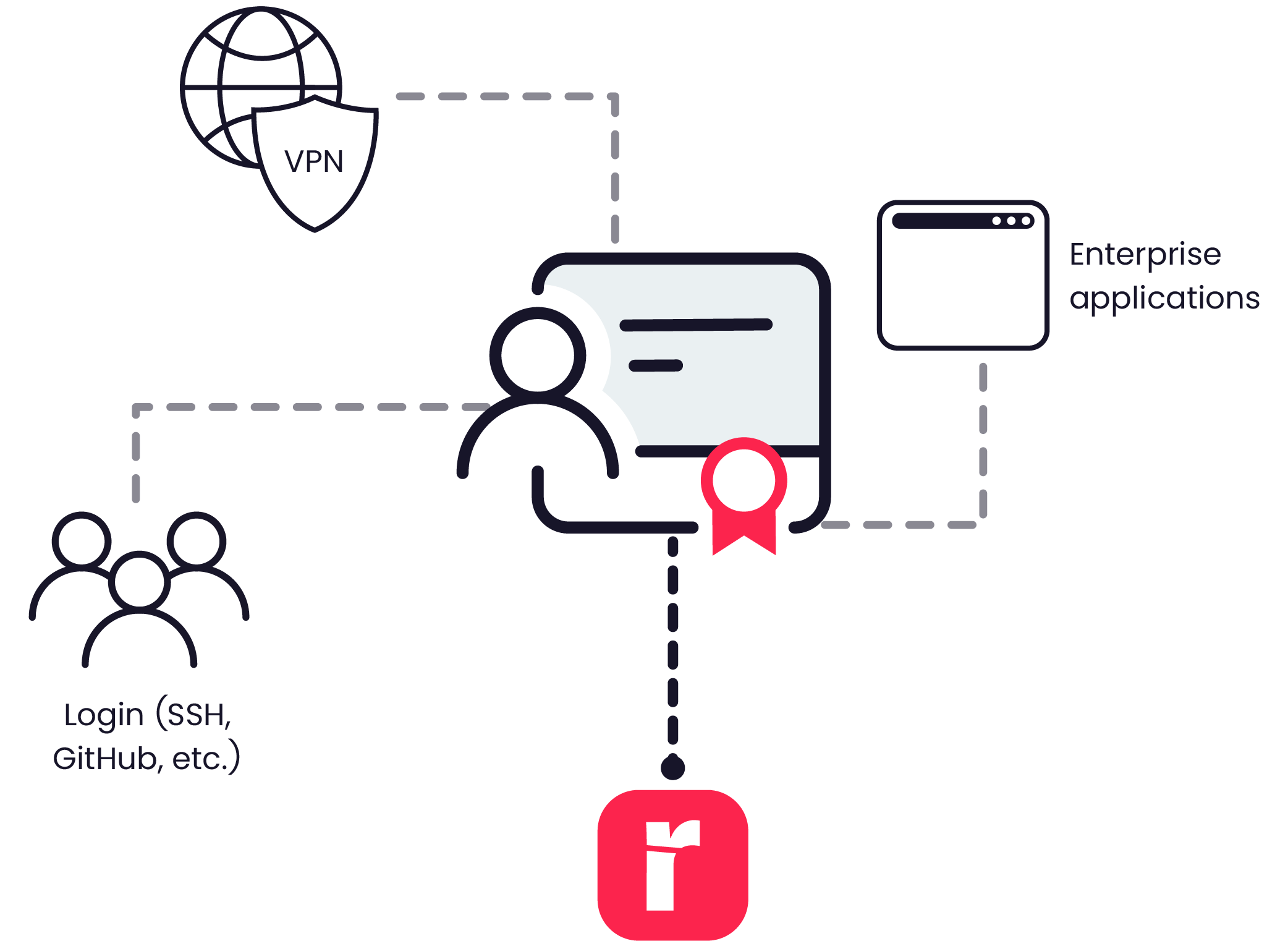
Control any corporate access with certificates
No matter what resource users need to access: enterprise applications and systems, Bitbucket or GitHub repositories, VPNs, cloud environments, or SSH services.
All certificate-based access activities are audited in Redtrust and can be efficiently managed from the administration console.
Passwords aren’t going away, but your access strategy shouldn’t depend on them
Implement Certificate-Based Authentication, assign a unique digital identity to every employee, and centralize certificate management in Redtrust to take access control and security to the next level.